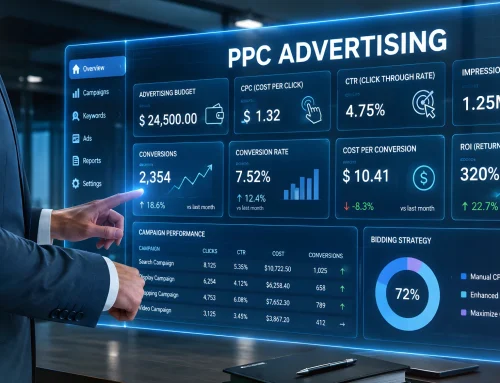

Relying on one advertising platform can limit the number of potential customers your business reaches. Google Ads commands enormous search visibility, while Microsoft Advertising provides another valuable channel for connecting with people actively searching for products and services.
Using both strategically can diversify your paid search presence without simply duplicating the same campaign twice. If you’re searching for “PPC company near me,” understanding how experienced campaign management coordinates multiple platforms can help you make a more informed marketing investment.
At Stratedia, we create, execute, and manage PPC campaigns around the needs and goals of each business.
Why Use Google and Microsoft Advertising Together?
Google Ads is often the natural starting point for paid search because of Google’s enormous search audience. But that doesn’t mean every PPC dollar automatically belongs on one platform.
Microsoft Advertising gives businesses another opportunity to appear when potential customers are actively searching. Running campaigns across both networks can expand exposure while providing additional performance data to evaluate.
The objective isn’t simply to appear in more places. Your campaigns should generate meaningful actions such as calls, form submissions, purchases, or other conversions that matter to your business.
Don’t Simply Duplicate Your Campaigns
Importing or recreating a successful Google Ads campaign on Microsoft Advertising can provide a useful starting point, but the campaigns shouldn’t necessarily remain identical.
Performance can differ between platforms. Search volume, competition, cost per click, audience behavior, and conversion rates may vary considerably.
Monitor results separately and adjust:
- Keywords and negative keywords
- Bids and budgets
- Ad messaging
- Geographic targeting
- Devices
- Scheduling
- Landing pages
Treating each channel according to its actual performance gives you greater control than applying the same strategy everywhere.
Allocate Budget According to Results
You don’t have to divide your advertising budget evenly between Google and Microsoft.
Start with clearly defined goals and measure how effectively each platform contributes to them. One may generate substantially more traffic while another produces fewer clicks at an attractive acquisition cost.
Instead of making budget decisions based solely on clicks, evaluate the metrics connected to business results. Depending on your campaign, those could include conversion rate, cost per lead, cost per acquisition, qualified calls, or revenue.
A knowledgeable PPC company near you should continually use this information to determine where additional advertising dollars have the greatest opportunity to perform.
Keep Search Intent at the Center
Successful PPC begins with understanding what someone wants when entering a search.
Broad keywords can generate traffic without necessarily attracting qualified prospects. More specific searches often reveal stronger intent and provide opportunities for ads and landing pages to answer exactly what the searcher needs.
Keyword strategy should therefore include more than identifying phrases with search volume. Search terms should be reviewed regularly so irrelevant queries can be excluded and promising opportunities can receive greater attention.
That ongoing refinement helps protect your advertising budget from unnecessary clicks.
Make the Landing Page Part of Your PPC Strategy
Even an excellent advertisement can struggle when it directs visitors to a weak landing page.
Someone clicking an ad should immediately understand what you’re offering and what to do next. Maintain consistency between the search term, advertisement, and destination page while providing a clear path toward conversion.
Strong landing pages generally benefit from focused messaging, prominent calls to action, easy navigation, and a good mobile experience.
PPC performance is ultimately about what happens after the click, not simply how many clicks an advertisement receives.
Measure, Test, and Refine
Paid advertising provides valuable performance data, but that information only becomes useful when you act on it.
Testing ad copy, keywords, calls to action, landing pages, bidding decisions, and targeting can reveal opportunities that weren’t obvious when the campaign launched. Rather than making sweeping changes based on assumptions, use measurable results to guide optimization.
This continuous approach also helps your campaigns adapt as competition, customer behavior, and business priorities change.
Build a More Complete PPC Strategy
Google Ads and Microsoft Advertising don’t need to compete for a place in your marketing strategy. Used effectively, they can complement each other by expanding your paid-search presence and providing additional opportunities to connect with customers.
At Stratedia, we manage PPC campaigns with an emphasis on strategy, execution, and continued optimization. If you’ve been searching for a “PPC company near me,” contact our Mystic, CT team to discuss how paid advertising can fit into your broader digital marketing strategy.